The Gym in Saida Where Nobody Watches You Train
Ask the young women who train with Iman what kept them out of a gym, and the answers are not about fitness.
They talk about who gets to watch them. The gyms available to them are mixed spaces with male trainers, and several say they were not taken seriously there. And then there are the exercises themselves: bending, jumping, squatting. None of it something you want to do with men watching.
They talk about money, too: $50 to $100 a month for membership and $30 a session for a trainer. For many, spending this amount exceeds their ability.
And for a young woman who uses a wheelchair, none of it is even the point, because no gym in the city employs a coach trained to work with her.
Nobody builds a team or a gym under those conditions. Iman built both.
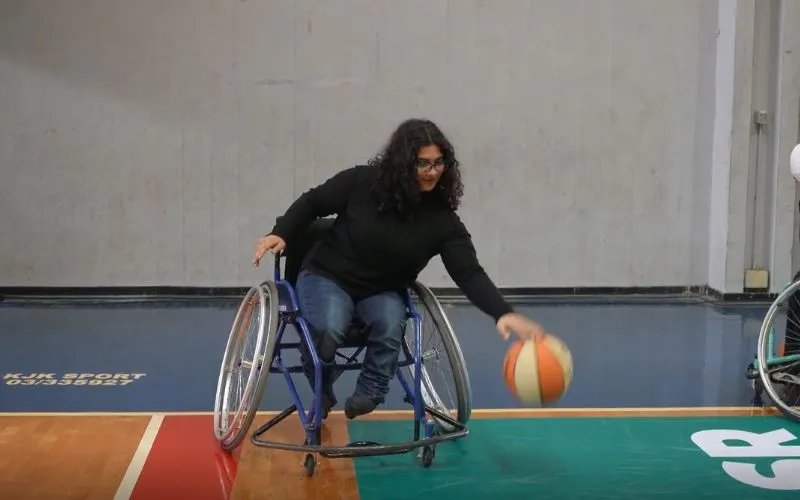
Iman is a coach and the founder of the Adaptive Sports Centre (ASC), a women-led organization in Saida’s Dalla neighbourhood that uses sport for development to break the barriers keeping girls, young women, and young people with disabilities out of community life. She founded its wheelchair basketball team in 2017. This was the first wheelchair basketball team for girls and young women in Saida.
A Ground Floor, a Rubber Floor, and No Males
Iman built the gym she could not find.
“I wanted to create a safe, private, and comfortable space where girls and women can exercise freely without having to share the gym with men,” she says. That matters most, she adds, for women who wear hijab, who can then “move, train, and dress freely without feeling self-conscious.”
It was never only about fitness.
“My goal is not only to promote physical health and well-being, but also to empower women, build their confidence, encourage independence, and strengthen our community.”
The other half of the idea came from 9,000 kilometres away. Iman spent time at an adaptive gym in Washington, and watched what it did for the people training there.
“Seeing how physical activity and an inclusive gym environment could improve their confidence, independence, physical abilities, and overall well-being gave me the idea and motivated me to bring the same concept to Lebanon,” she says.
The gym Iman built sits on the ground floor, because nobody should have to climb stairs to reach a workout, and the flooring is rubber and matted, so a wheelchair crosses it safely.
Members train in whatever they find comfortable. Nobody watches them lift. They can tell Iman when they are on their period and move a session without explaining themselves — a small thing, and the reason several of them stayed.
A session costs $10, against $30 for a trainer anywhere else in the city. Members with disabilities who cannot afford it train for free.
“This Is the Change That I Achieved”
Rim, 17, is a student with a visual impairment who has trained with Iman for two years. She did not come for basketball, and she did not come for a medal.
“My goal was to lose weight to improve my health, increase my energy, and gain healthy habits that help me in my daily life,” says Rim. “And this is the change that I achieved.”
Now, she tells other young people to join.
Through the European Union-funded WE'AM project, Right To Play helped expand what Iman had started: adapted equipment, coaching support, and transport to an accessible court in Beirut when the wheelchair team needs more space.
“Through this project, we’re creating a safe space for community members to come together, build relationships, and heal.”
The project has ended. The gym is still open: members who can afford the fees pay them, and Iman keeps training the ones who cannot.
In October 2026, her players won both their games at the Lebanon Wheelchair Basketball Championship, a national competition, beating the Wheelers and the Sonics in the top division.