Antou Was Meant to Be Married — Instead, She Found Her Way Back to School
There's a moment in every classroom when a child stops waiting to be called on and just raises their hand. For Antou, that moment came later than it should have — but it came.
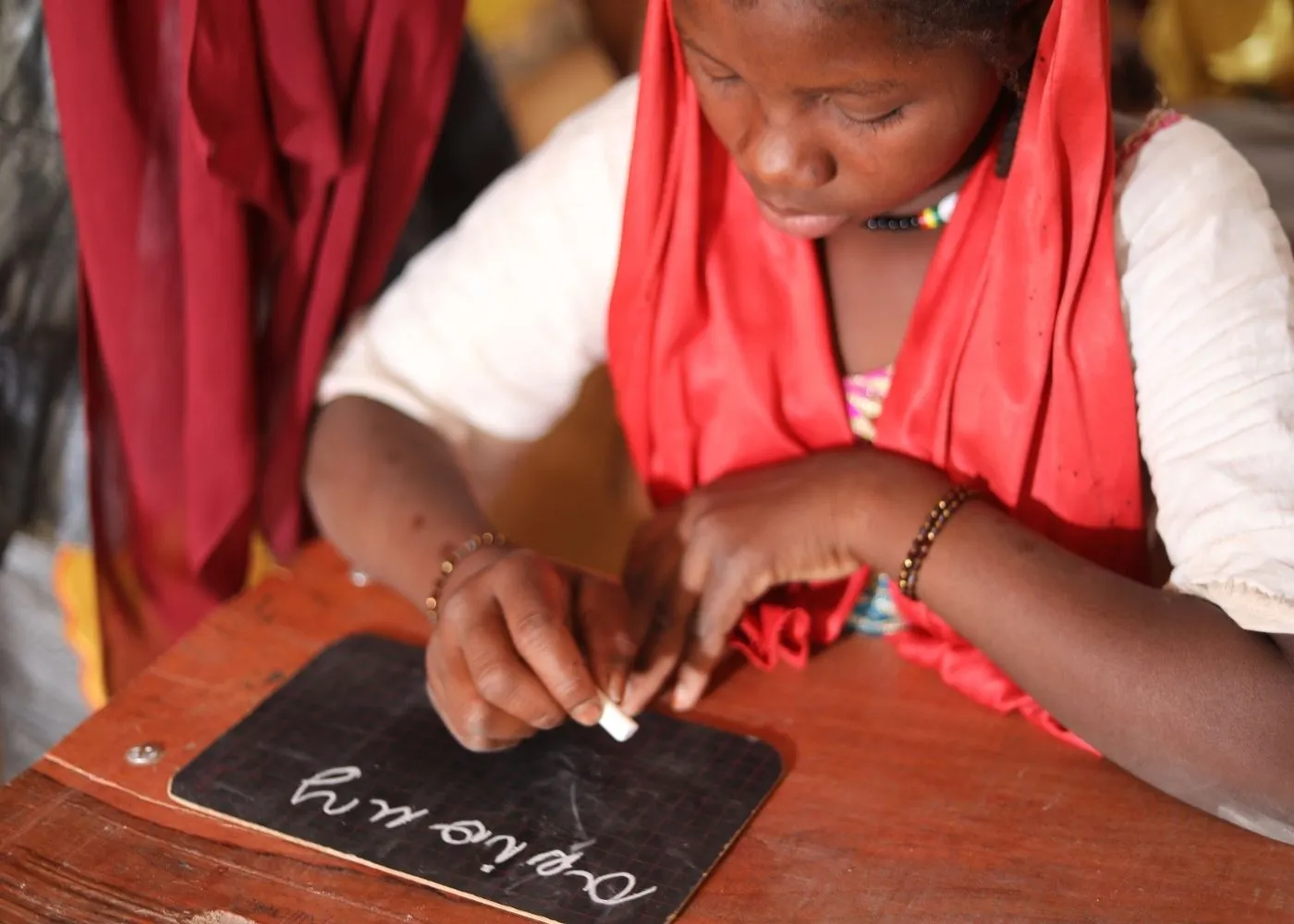
Today, at 12, she reads aloud to her class at a temporary learning centre in Sévaré. She does it loudly. She does it well. Her classmates clap.
Less than a year ago, Antou's future was being decided without her.
Her family had fled violence in Douentza, joining the thousands of internally displaced people who arrived in Sévaré with little more than each other. Displacement, as it so often does, brought compounding crises: no documents, no school placement, and a growing pressure to marry — driven more by survival than cruelty. In communities where girls are cut off from education, l, their futures can quickly narrow, and they’re too often reduced to burdens that families struggling to survive can longer afford to carry.
The Weight Behind The Numbers
Mali has one of the highest rates of child marriage in the world — roughly 52% of girls are married before the age of 18, and for displaced communities, that risk climbs higher still.
For girls like Antou, displacement doesn't just mean losing a home. It means losing the paperwork that proves you exist. Without a birth certificate, she couldn't enrol in school. Without school, the case for keeping her unmarried grew harder to make.
That's when Mariam heard about her.
Mariam is the president of AKOS, a community-based organisation in Sévaré trained and supported through the EMPOWER project. She is the kind of local leader who doesn’t wait for a referral — she knocks on doors, sits with families, and speaks plainly about rights in a language communities trust: her own.
With support from EMPOWER, Mariam received training and built connections with local child protection authorities, giving her the knowledge and support needed to intervene in Antou's case. She worked with local authorities to stop the marriage and guided the family through the process of securing Antou's birth certificate.
"When I heard about this little girl, I said: no. Not if I can help it," Mariam recalls.
EMPOWER — funded by Global Affairs Canada and implemented by Right To Play — works in fragile and conflict-affected settings to ensure that displaced and vulnerable children, especially girls, can access safe, inclusive education. In Mopti, that means not just building classrooms, but building the community conditions that allow girls to fill them.
Antou’s case didn’t just change one life — it shifted conversations across the community.
“Antou’s case brought positive change,” Mariam explains. “It helped open discussions within the community. Now, if cases of child marriage arise, people say, ‘We should contact AKOS.’
The Turning Point
Within weeks of enrolling at the temporary learning centre — a safe space created through the EMPOWER project to help out-of-school and displaced children catch up academically and transition into formal education— Kadidiatou, Antou’s teacher, noticed something shift.
She had arrived quiet, head down — the posture of a child who had learned that being noticed wasn't always safe. “When Antou arrived at the temporary learning centre, she was very shy and struggled to learn,” Kadidiatou recalls. But the learning centre, designed around child-friendly, play-based methods, didn't ask her to sit still and absorb. It motivated her to participate. To debate. To act things out. To be wrong out loud and try again.
"She started joining the games," Kadidiatou says. "Then she started helping other children understand the games."
"She arrived timid. Now she is the one who raises her hand first."
Her academic progress has tracked her confidence closely. She is now among the strongest readers in her group — a fact her teacher mentions with obvious pride.
Her guardian, who once faced a decision shaped more by circumstance than choice, is now among the strongest supporters of her education.
What Antou Wants Next
Ask Antou what she wants to be when she grows up, and she doesn't hesitate.
"I want to help girls like me," she says. "Girls who people want to stop."
It's a sentence that holds the whole story inside it — the fear, the intervention, the recovery, and the ambition that survived all three. Antou doesn't talk about her future in the passive tense anymore. She doesn't wait to see what happens to her. She has plans.
AKOS continues to run community awareness sessions on child marriage across Sévaré — sessions that bring men and women together, that treat the practice as a shared problem rather than a women's issue, and that are slowly, measurably, shifting behaviour.
The EMPOWER project supports displaced and conflict-affected children in Mali to access safe, inclusive, and quality education through community-based organisations, child-friendly learning environments, and social behaviour change programming. EMPOWER is supported by the Government of Canada through Global Affairs Canada.
